


East Melbourne VIC 3002

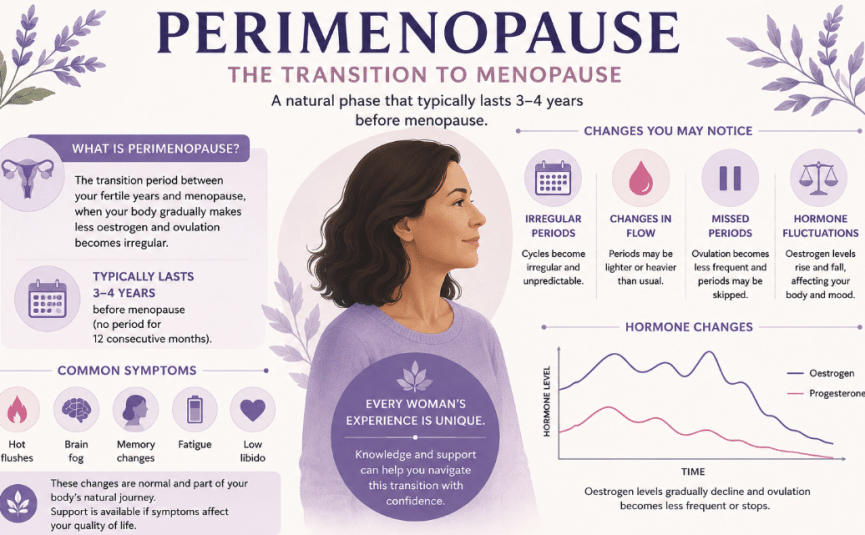
The transition period between you being fertile, ovulating and having a regular cycle and the menopause, where you have not had a period for 12 months, is called the perimenopause. This is a period of 3-4 years prior to the menopause. It is often a period of time when your periods become more irregular and unpredictable. What regulates your cycle is the brain centre that regulates the secretion of pituitary hormones. FSH is the hormone that triggers the development of an egg, and the pituitary hormone LH triggers the release of that egg at midcycle. There is a biological constant that keeps your periods regular that is, from the time that you ovulate to the time of your period is always around 14 days, so naturally we expect a regular cycle. However, during the perimenopause, when ovarian function is slowly reducing and the production of oestrogen especially, is slowly reducing, the menstrual cycle becomes more and more irregular. This is because ovulation is either absent or ovulation is inadequate. This is why periods become irregular.
At the beginning of the perimenopausal period, called the early phase, the interval between one period and another can either become shorter, you may have two periods a month, and this is called polymenorrhoea or the distance between periods may become longer which is more common, and this is called oligomenorrhoea. The unpredictable nature of your period as well as the variation in the amount of blood loss, can be unsettling or confusing.
Typically, in the late phase of the perimenopause, your periods become even more irregular, and you may start missing periods altogether, a sign that you are not ovulating at all.
Pregnancies after the age of 45 are uncommon because older eggs are less able to be fertilised, and often women are either no longer ovulating or are having poor ovulation. This is a normal physiological state. Your brain is programmed to go through these phases: a pre-pubertal phase, puberty, followed by a fertile phase, followed by a phase in your 40’s called the perimenopause, where fertility is very infrequent, then followed by the menopause itself.
As we have mentioned, the commonest thing that women notice is a variation in the length of their menstrual cycle, which can be initially shorter but as time goes on, is more likely to be a longer interval between periods and then missing periods altogether. With this change in the menstrual cycle, it is not uncommon to notice a lightening of the menstrual blood loss or often periods become heavier because you are no longer making a hormone called progesterone that stabilises the lining of your uterus, as you only really make progesterone after ovulation, which as we mentioned, becomes less common.
These variations in your menstrual cycle in the perimenopausal period are normal and a part of the normal physiology of the female reproductive cycle.
Especially in the late phase of the perimenopausal cycle, as your oestrogen level is slowly reducing, oestrogen deficiency symptoms start to become more obvious. These symptoms include hot flushes, brain fog, memory loss, fatigue and poor libido. If these symptoms are interfering with your quality of life because of their severity, then menopausal hormone replacement therapy can be discussed as an option.
So, it is important to be aware of whether or not the symptoms are becoming a problem and interfering with your well-being.
As we have mentioned, the perimenopause and its consequences are a normal physiological part of life. However, the severity of symptoms during this period varies significantly between different women. Therefore, there are some symptoms that need to be attended to with the help of your medical practitioner. The symptoms that should act as a warning sign and suggest that you seek medical help include:
- Oestrogen deficiency symptoms that are interfering with your quality of life
- Bleeding during your cycle that seems significantly abnormal, such as bleeding after intercourse (postcoital bleeding).
- Very heavy bleeding during your period, significant pelvic pain, or very heavy menstrual loss.
- Any symptom that interferes with your quality of life or any symptom that is of concern to you.
- If you have any of these symptoms or concerns, it is important that you do not ignore them because they can go on for months or even years, and there may be a significant cause for these symptoms that is not always explained by the physiology of change.
Perimenopause is different for every woman, but one thing that is consistent is that it is important for you to know what is happening to your body, so you can find this a period of less stress and less unpredictability. If you feel that you need to see a medical practitioner because of the concerns that we have mentioned above, Associate Professor Len Kliman has been managing these problems for over 30 years and provides a sensitive, caring approach to symptoms that may be unpredictable and difficult.