


East Melbourne VIC 3002

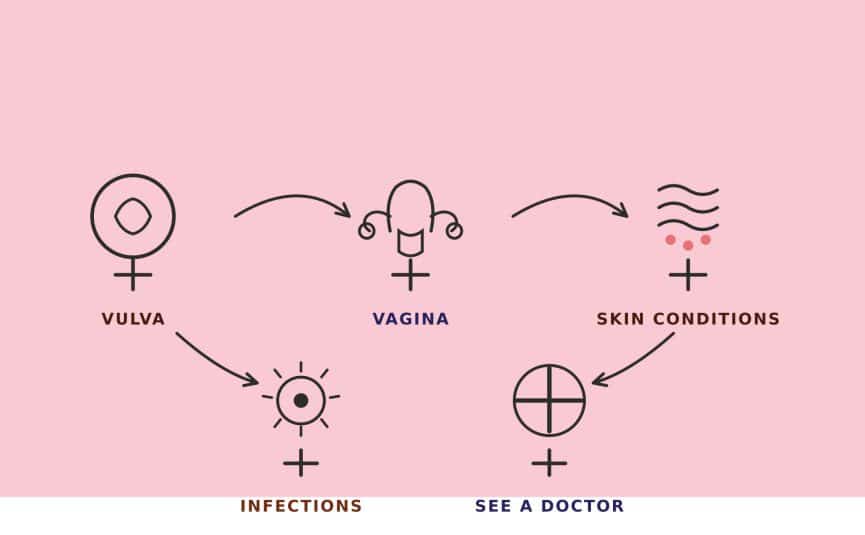
The vulva is the skin outside the vaginal opening. The top small areas of skin that are adjacent to the clitoris are called the labia minora. Below the labia minora, there are large mounds of hair-bearing skin called the labia majora. The area of skin between the lower part of the vaginal opening and the anus is called the perineum. All these areas together make up the vulva. The tube that goes from the vaginal opening up and backwards towards the cervix is called the vagina, and it is lined by a different skin called the mucosa. The cervix protrudes into the top of the vagina.
Common symptoms of a vulval or vaginal condition include itch, burning, pain, skin redness and swelling and splits (fissures) or areas of ulceration.
Some conditions affect just the vulva; some conditions affect just the vagina, and there are disorders that affect both the vulva and the vagina. Conditions can be localised to the genital area alone, or there may be evidence of the same disorder elsewhere in the body, on other areas of skin, for example.
It is always important to come up with the correct diagnosis in dealing with genital conditions. The correct diagnosis leads to the correct treatment.
It is sometimes difficult to know whether a disorder is localised to the vulva or includes the vagina. An accurate diagnosis will help sort out the site of the disorder and the most appropriate treatment. Infections commonly involve both the vulva and vagina, and a diagnosis will allow the correct treatment and the correct site to be established.
The vulval skin is a particularly sensitive area and is prone to a number of dermatological conditions that are not related to infection.
There are a number of immune skin disorders, such as lichen sclerosus and lichen planus, which are immune skin disorders resulting in significant inflammation and in the case of lichen sclerosus, fibrosis of a skin layer. These need to be assessed carefully and treated with high-potency steroids and followed in the long term because of their association with precancerous and cancerous skin disorders of the vulva. Skin disorders of the vulva can be associated with inflammation and redness, and associated swelling, itching and burning.
Besides the skin disorders mentioned, there are other skin disorders, such as chronic dermatitis, also called lichen simplex chronicus, as well as other forms of dermatitis, such as contact dermatitis and eczema. Another immune skin disorder is psoriasis, and that is not uncommon. It is essential to exclude precancerous disorders, which can be associated either with lichen sclerosus or more commonly with HPV infection of the vulva. Fungal infections of the vulva are quite common, especially Candida albicans (thrush).
To differentiate these skin conditions, a vulvoscope or microscope that visualises the vulva closely and a biopsy under local anaesthetic may be required as a number of skin disorders look very similar.
For example: redness and swelling can be seen in lichen planus, plasma cell vulvitis, candida albicans infections, precancerous skin change, psoriasis, eczema and dermatitis. Therefore, a biopsy may be essential for a correct diagnosis.
The vagina has a microbiome or environment that either discourages infection or helps infections to develop. This environment involves the presence of protective germs such as lactobacilli. Some varieties of lactobacilli release lactic acid, and this acidifies the vagina. The normal vaginal pH is supposed to be between 4 and 4.6. Any pH less than 7 is acidic. Therefore, the vagina is supposed to have an acidic environment, and this environment inhibits the growth of infections and promotes the growth of protective germs. It is the change in the normal pH in the vagina that tends to make you prone to vaginal infections.
The commonest vaginal infection is Candida albicans or thrush, which may be present in the vagina or both the vagina and vulva. It is associated with a cream cheese-like vaginal discharge. The other common vaginal infection is bacterial vaginosis, where the vaginal environment is too alkaline and not acidic, and this promotes the growth of a particular type of organism, which results in a grey-green, thin discharge and an unpleasant odour.
To determine whether the vaginal skin disorder is due to an infection or a skin disorder, tests for infection need to be taken and sometimes, if a vulval skin disorder is thought to be present, a biopsy may be needed. One of the commonest of these vaginal skin disorders is desquamative inflammatory vaginitis (DIV). As all inflammatory skin disorders in the vagina can look similar, a biopsy may be necessary to differentiate them. The skin disorder that we can see on the vulva, which is called lichen planus, can also involve the vagina and again, a biopsy may be necessary. Treatment can involve the use of compounded pessaries or creams.
Both with the vulva and with the vagina, the symptoms of a skin disorder, such as an immune skin disorder and the presence of infection can be difficult or complex. Certainly, certain conditions have a typical appearance, and secondly some disorders are associated with a distinct discharge which is present and can be tested for infection. The use of vaginal smears and cultures for infection, a PCR test, which is similar to a COVID test for specific organisms and the use of a vulval or vaginal biopsy may be helpful in finding out exactly what the condition is.
It is important to realise that vulval and vaginal symptoms such as itch or burning are particularly common, and it is estimated that over 50% of women will have these symptoms at some stage of their life. You do not need to be embarrassed or overly concerned as in almost every patient, a diagnosis and appropriate treatment is available. However, as already stated, it is important to get the diagnosis right so that the correct treatment can be applied.
- Unexplained vulval or vaginal symptoms
- Vulval or vaginal symptoms that have not resolved with treatment.
- The presence of skin lesions such as fissures, splits or ulcers
- Where the condition is recurrent, including common recurrent infections, such as Candida albicans or bacterial vaginosis
It is important to realise that help is always available with either symptoms that are interfering with your quality of life, symptoms that are recurrent or prolonged and lesions which may be precancerous or cancerous. Associate Professor Len Kliman has had a long interest in vulval skin disorders and the use of a vulvoscope or microscope, and the use of a biopsy under local anaesthetic, where necessary.